Why we investigated llms.txt adoption
llms.txt is a lightweight summary file that tells AI crawlers about "the
structure of a site." Proposed in 2024, it has been drawing attention since
2025 as a reference target for major AI crawlers including ChatGPT, Claude,
and Gemini.
To clarify the structural factors behind AI citation acquisition, GEO Meter
has internally analyzed the correlation between llms.txt deployment and AI
citation ranking. This article shares the patterns confirmed at this point.
Smoke analysis: observation across 2 Topics × 20 domains
The scale of the initial smoke analysis GEO Meter conducted internally is as follows:
- Target Topics: 2 (otaku-oriented travel / fat-reduction-related)
- Target domains: Top and bottom AI citation cohorts within each Topic, totaling roughly 20 domains
- Observation period: April – May 2026
This scale does not claim a statistical industry-wide trend; it is closer to a qualitative analysis aimed at an initial understanding of "what differs between the top and bottom cohorts."
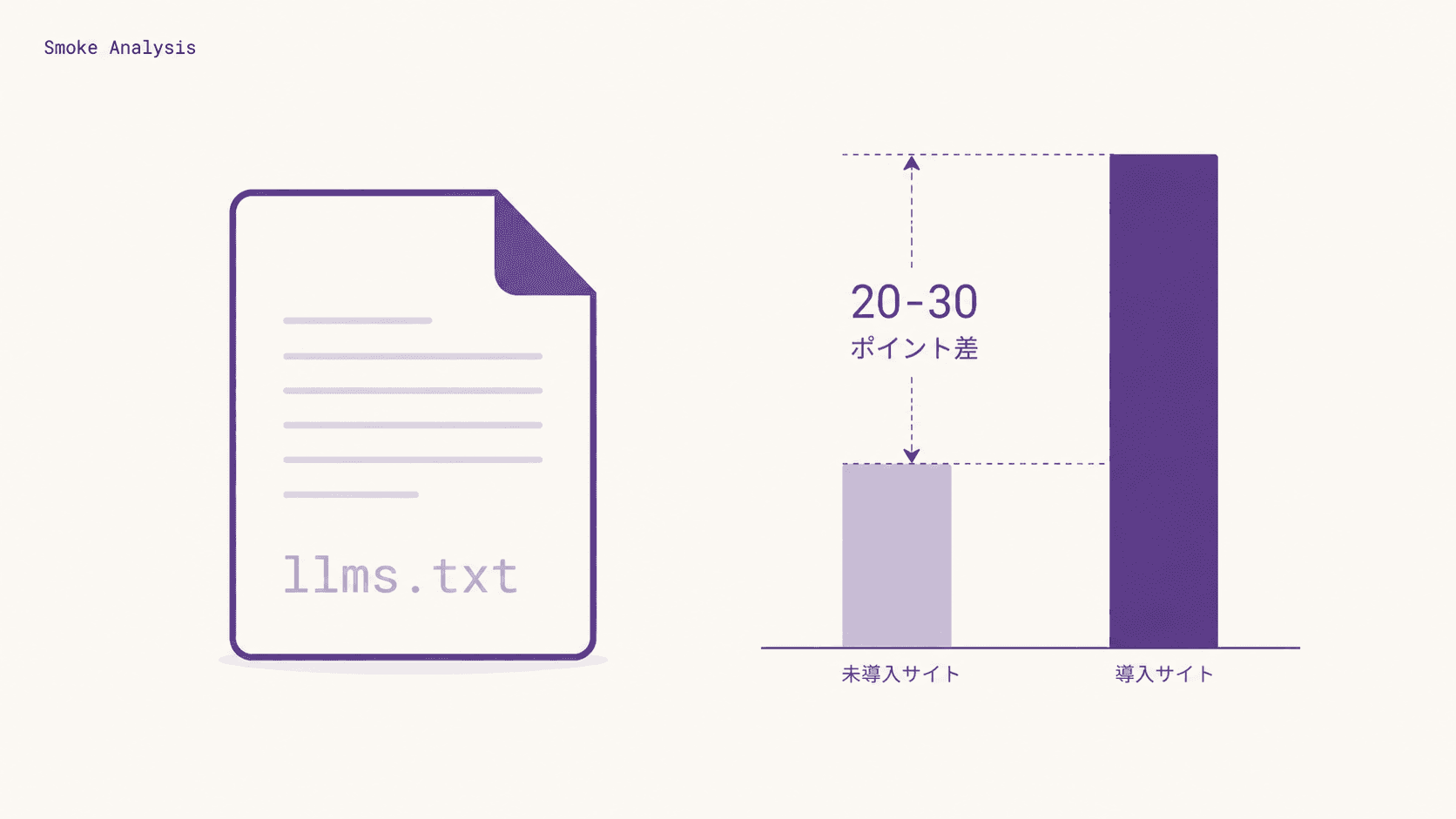
Key observation: +20 to +30pp gap in adoption rate
Within the smoke scope, comparing the top and bottom AI citation cohorts, we
observed a +20 to +30pp gap in llms.txt adoption rate.
- Otaku-oriented travel Topic:
has_llms_txttop cohort 40% vs bottom cohort 10% (+30pp) - Fat-reduction Topic:
has_llms_txttop cohort 20% vs bottom cohort 0% (+20pp)
The sample size is too small to generalize to entire industries, but within the smoke, we consistently confirmed that the top cohort has a higher adoption rate.
Characteristics of the domains that did maintain it
Visual inspection of the domains that maintained llms.txt revealed the
following characteristics (quantification is future work):
- They list URLs of key pages under headings such as
## Main Pages - Each URL is accompanied by a concrete one-line description
- Sites that explicitly mark the existence of an FAQ page with
## FAQwere notable - File size stays within a few KB, with no excessive bloat
We plan to quantify these observations in fuller investigations in coming months.
Why we believe llms.txt works for citation acquisition
The reasons we believe llms.txt helps with AI citation are as follows:
- It may function as a "priority guide" for AI crawlers
- By providing a summary of the site structure, it creates conditions in which AI "can more easily understand the context" of a citation source
- The very fact that it is maintained acts as a signal of "operation conscious of AI search," and sites that maintain it tend to also have related structured implementations (Schema.org / FAQ pages, etc.)
This third perspective is important: rather than being an effect of llms.txt
in isolation, it may indirectly signal "the overall structure of an AI-search-friendly site."
First moves if you have not yet set it up
If llms.txt is not deployed, we recommend starting in the following order:
- STEP 1 (about 15 minutes): List 5–10 key URLs
- STEP 2 (about 20 minutes): Write a one-line description for each URL (be concrete)
- STEP 3 (about 10 minutes): Place
llms.txtat the site root - STEP 4 (ongoing): Update the contents monthly
For detailed writing guidance and samples, see the
llms.txt Complete Implementation Guide.
Plan for future investigation
This article's smoke analysis was a small-scale study of 2 Topics × about 20 domains. GEO Meter is progressively expanding the Topics under observation, and we will go deeper in stages on per-industry adoption rates and on the correlation between file size and citation ranking.
As soon as the investigation scope expands, we will publish additional reports.
→ llms.txt Complete Implementation Guide
→ Diagnose your AI search visibility in 60 seconds